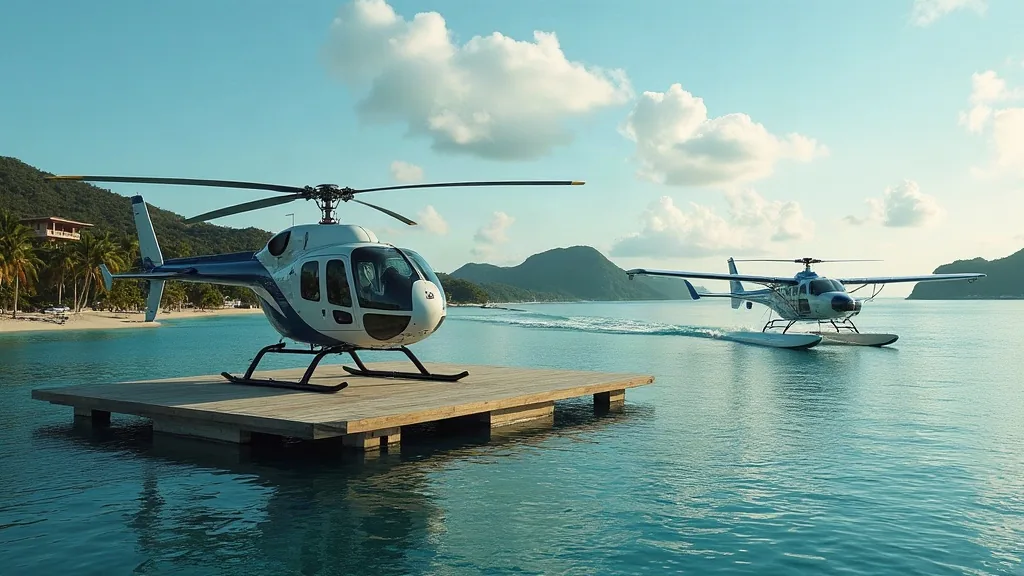
Choose a helicopter when there is no water landing site and you need point-to-point speed to a helipad or open field. Choose a seaplane when the destination is a lagoon, bay or resort jetty, or when a group needs the cabin and baggage volume of a Cessna Grand Caravan EX amphibian or a DHC-6 Twin Otter floatplane. As of 2026, helicopter charter in Indonesia is an established, bookable service; seaplane operations are mostly start-up and trial-stage.
Both modes solve the same problem — skipping a slow road or boat transfer — but they solve it differently, and in Indonesia today they are not equally available. This page lays out what each aircraft actually does well, where the honest gaps are, and how to get both quoted for the same trip.
Is a Seaplane Cheaper Than a Helicopter in Indonesia?
No public source publishes route-level fares for either mode in Indonesia, so no comparative price figure can be given honestly. Seaplane operators such as Santai Seaplane (PT Santai Seaplane Aviation) and Sama Sama Seaplanes quote charters on enquiry rather than a public tariff, and helicopter charter pricing in Indonesia is similarly quoted per operator, per route and per aircraft type. What actually drives cost on either side is consistent across operators: aircraft type and fuel burn, one-way versus round-trip positioning, group size against seat count, and whether the trip is a shared slot or a full private charter. Anyone quoting a fixed IDR or USD figure for a “seaplane vs helicopter” route without naming the operator and date should be treated as guessing.
Which Is Safer: Seaplane or Helicopter?
Both modes operate in Indonesia under Directorate General of Civil Aviation (DJPU) oversight, with the Directorate of Airworthiness and Aircraft Operations (DKPPU) issuing type certificates and commercial operators required to hold an Air Operator Certificate — a virtual carrier such as Sama Sama Seaplanes flies under another AOC holder’s certificate instead. Helicopter charter has a longer operating track record in Indonesian tourism and VIP travel. Seaplane operations are newer here: a demonstration flight and water landing is a regulatory prerequisite before a site is approved for commercial use, which is why Seaplane Asia Group’s demonstration flight was a required step, not a marketing event. Neither mode’s safety record is a number we can cite without a named source, and none should be quoted without one.
Which Is More Scenic?
A seaplane’s approach and departure over open water — a bay, a lagoon, a stretch of coastline — is a different visual experience from a helicopter’s ability to hover, bank tightly and hold a fixed vantage point over a single landmark. For a slow descent into a resort bay or a low pass along a coastline, a seaplane’s fixed-wing glide reads differently than a helicopter’s rotor-driven hover. For circling a single crater, reef or waterfall repeatedly, a helicopter’s manoeuvrability wins. Neither is objectively “more scenic” — it depends on whether the brief is a scenic transfer or a photography/filming hover.
Seaplane vs Helicopter: Attribute Comparison
| Attribute | Seaplane (Cessna Grand Caravan EX / Twin Otter) | Helicopter |
|---|---|---|
| Landing surface | Water only — bay, lagoon, calm coastal stretch, or a certified water aerodrome (Bawah Island has one) | Helipad, open field, ship deck, or any cleared flat surface |
| Cabin size (manufacturer-published) | Textron’s Grand Caravan EX literature lists a standard cabin behind the pilot seat, typically configured for up to nine passengers on wheels; amphibious-float configurations used in Indonesia usually carry fewer to offset float weight and fuel. Viking Air’s Twin Otter Series 400 is rated up to 19 seats on wheels; the floatplane variant at Bawah Reserve runs a smaller group config | Varies by model; light-to-medium charter helicopters common in Indonesia typically seat four to six passengers |
| Luggage/gear capacity | Larger hold relative to helicopters — useful for dive gear, filming equipment or a family’s luggage | Limited to a small cargo compartment or under-seat space |
| Noise | Viking Air markets the Series 400 on Wipline 8000 floats as lower-noise per Kemenhub’s Trans Utama reporting | Rotor noise is audible on approach and departure; varies by model |
| Weather constraints | Needs calm water (wave height, wind) at both ends, in addition to normal VFR/IFR limits | More tolerant of rough terrain below but still constrained by wind, visibility and cloud ceiling |
| Scenic experience | Low fixed-wing approach/departure over water | Hover and close-orbit over a fixed point |
| Availability in Indonesia (as of 2026) | Few operators, mostly start-up/trial: Santai Seaplane targeting Banyuwangi and Letkol Wisnu Airport (Buleleng) from 2026; Sama Sama Seaplanes planning West Sumatra routes; Bawah Reserve’s two Twin Otters already flying | Established charter market with multiple operators across Bali and other hubs |
Which Mission Fits Which Aircraft?
| Mission | Better-suited mode | Why |
|---|---|---|
| Resort or liveaboard transfer to a bay/jetty | Seaplane, where a certified water site exists | Lands directly at the water’s edge; no tender boat needed |
| Medical evacuation | Helicopter today; seaplane role still developing | Helicopters can reach a hospital helipad directly; BRIN’s N219A ecosystem work targets medevac and remote logistics but the aircraft is not yet in commercial service |
| Aerial filming/photography | Helicopter | Hover and tight-orbit capability suits repeated passes over one subject |
| VIP point-to-point (no water leg) | Helicopter | Can land at a helipad, estate or event site without needing a water aerodrome |
| VIP transfer where the destination is on the water | Seaplane, subject to site certification | Matches the aircraft to the destination without a boat transfer |
What Actually Drives the Cost, Since Fixed Rates Aren’t Public
Rather than publish a number neither aircraft’s operators have made public, here is what changes the quote you’ll receive:
| Cost driver | Effect |
|---|---|
| Aircraft type and size | A Twin Otter or larger helicopter costs more to operate per flight hour than a smaller Caravan or light helicopter |
| Route distance and positioning | A charter often bills for the aircraft’s flight to and from base, not just your leg |
| Group size vs. seat count | A private charter for two people in a nine-seat aircraft costs the same as for nine |
| Water site certification (seaplane only) | A route to an uncertified bay may not be quotable yet, regardless of budget |
| Season and demand | High season and holiday dates affect helicopter availability more than price transparency |
How Booking Works
- Send your route and party size. Tell the desk where you’re starting, where you’re headed, how many passengers, and any luggage or gear (dive equipment, filming gear).
- We check both options. The desk contacts licensed helicopter operators and, where a certified or planned water site matches your route, seaplane operators, and confirms current availability for your dates.
- You receive both quotes side by side. Aircraft type, seat configuration and any water-site caveats are stated plainly — no invented fares.
- You confirm with the licensed operator. Juara Holding Group, an independent coordination desk established in 2015, arranges the booking directly with the licensed operator; it does not own or operate the aircraft.
Send your route and passenger count via WhatsApp to +62 811-3941-4563 or email bd@juaraholding.com, and the desk will come back with a licensed helicopter option and a seaplane option — where a seaplane route currently exists — for the same trip.
Frequently Asked Questions
Do seaplanes fly to more places in Indonesia than helicopters right now?
No. Helicopter charter already operates across multiple hubs with an established network of licensed operators. Seaplane service is limited to a handful of sites — Bawah Reserve’s certified water aerodrome, plus planned or trial operations around Banyuwangi, North Bali and West Sumatra — so a helicopter currently reaches far more destinations on demand.
Can a seaplane land at any beach or bay in Bali?
No. A water landing site needs DJPU registration and, per current reporting, a demonstration flight before commercial water landings are approved there. Southern Bali and Menjangan have been named in reporting as sites under discussion, but there is no public, complete registry of every certified bay, so ask the desk to confirm current status for a specific location before assuming it’s approved.
Is a helicopter faster than a seaplane for a Bali resort transfer?
Point-to-point, a helicopter generally reaches a helipad faster because it skips the descent and taxi phase a water landing requires. No public source gives minute-by-minute comparative timings for Indonesian routes, so treat any specific “X minutes faster” claim as unverified unless it names its source.
What happens if the water landing site I want isn’t certified yet?
The route can’t be booked as a seaplane charter until DJPU registration and the required demonstration flight are complete at that site. In that case the desk will offer the closest certified alternative or a helicopter option instead, rather than promising a seaplane trip that isn’t yet operational.
Do I need a different operator for a seaplane versus a helicopter charter?
Yes — seaplane and helicopter charters in Indonesia are run by separate, specialised operators with their own Air Operator Certificates (or virtual-carrier arrangements). The coordination desk handles contacting both types on your behalf so you don’t have to identify and vet each operator yourself.